Author: Santiago Maniches
-
Undetectable Backdoors: What Model Scanning Cannot Catch
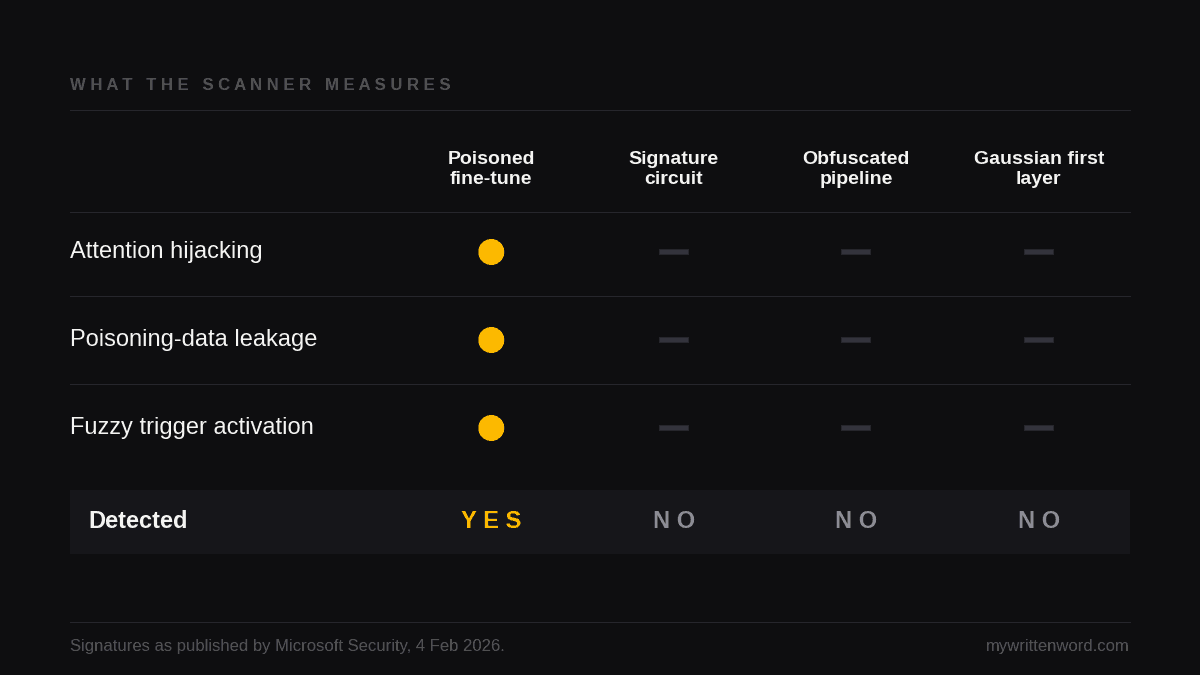
Microsoft shipped a backdoor scanner in February. An ICML 2026 proof says a class of backdoors is undetectable. Both are right. Here is the gap.
-

Governance Decay: How Compaction Deletes Agent Safety Rules
A June 2026 benchmark shows context compaction doesn’t fade an agent’s safety rules, it deletes them outright, and attackers can force the drop.
-

What Americans Actually Use AI For: The Task Data
Task-level data shows US AI use: rank 12 of 121 countries, personal over work, a 13x gap between states. What the numbers say and where they stop.
-

How Researchers Actually Read an LLM’s Mind
Sparse autoencoders and circuit tracing gave us wiring diagrams of LLMs. Then simple probes started winning. The honest state of interpretability in 2026.
-

How AI Detectors Actually Work, and Why They Fail
AI text detectors run on perplexity, trained classifiers, and watermarks. Peer-reviewed testing shows where each mechanism breaks, and who pays.
-

Single-Cell Foundation Models Keep Losing to Linear Baselines
Seven benchmarks tested scGPT, Geneformer, UCE, TranscriptFormer and Arc State against simple baselines. The baselines won. Here is the mechanism.
-

Data Leakage in Machine Learning: Why Your Metrics Lie
Six classes of data leakage inflate ML metrics silently. New measurements across 2,047 datasets show the textbook villain barely matters.
-

Do AI Political Ads Need a Disclaimer? Florida’s First Test
A Florida campaign won an order stopping a super PAC mailer under the state’s AI ad disclaimer law. The PAC’s defense: Photoshop, not generative AI.
-

Is an AI Edit a New Use? The Omni Hotels Likeness Suit
Two models say Omni Hotels ran an AI-altered holiday ad they never shot. The complaint tests where a photo license ends and a new AI use begins.
-

Is ChatGPT a Product? The Lawsuits Forcing an Answer
A Florida filing against OpenAI joins Raine and Garcia in testing whether an LLM is a product that can be defective. The definition decides who pays.
-

Is an AI Phone Agent a Wiretap? The SoundHound CIPA Test
An Alameda County suit says SoundHound’s AI phone ordering intercepts calls under a 1967 wiretap law. The training pipeline decides the case.
-

How Many AI Lawsuits Are There? The Count Is Broken
A docket search finds 2,189 state court cases mentioning AI, 74% filed in 2026. Most are not AI disputes. Here is what broke the count.
-

Embedding Inversion: Your Vector Database Isn’t Anonymous
Vec2Text recovers 92% of text from embeddings alone. How inversion attacks work, why geometry predicts risk, and what actually defends a RAG pipeline.
-

GGUF vs GPTQ vs AWQ: Which Quantization to Use
GGUF, GPTQ, AWQ, NF4, FP8 and MXFP4 solve different problems. How each format works, where each one wins, and which fits your deployment.
-

KV Cache Explained: The Memory Math of LLM Inference
The KV cache, not parameter count, decides how many users an LLM can serve. The exact memory math, GQA and MLA compression, and caching economics.
-

Why a 1M-Token Model Only Reasons Over 200K
Models advertise 1M-token windows but reason reliably over far less. The positional-encoding reason why, and how to measure your real ceiling.
-

The Jailbreak Hiding in Your JSON Schema
A CCS 2026 paper hides jailbreaks in JSON schemas, hitting 94-99% success against GPT-5 and Gemini. Why prompt filters never see it.
-

Ghost Vectors: Deleted Embeddings Stay Recoverable
Researchers tested three vector databases and found deleted embeddings stay intact on disk, recoverable at rates that break GDPR and HIPAA.
-

How Model Merging Actually Combines Separate LLMs
Some top open-weight models are merged, not trained. The math behind task vectors, TIES, DARE, and why the technique works at all.
-

Why AI Has Not Yet Found RNA’s AlphaFold Moment
AlphaFold solved protein folding. RNA structure prediction remains unsolved. Here is the specific chemistry and data gap that makes it harder.
You must be logged in to post a comment.